
Technology Feature: Wearable Sensor Offers Faster, Continuous Detection of Urinary Tract Infections
By: Crystal Carter
Texas A&M researchers led by Hatice Ceylan Koydemir, Ph.D., assistant professor in the Texas A&M University Department of Biomedical Engineering, have developed a wearable sensor designed to help detect urinary tract infections (UTIs) faster and provide continuous monitoring for catheterized patients.
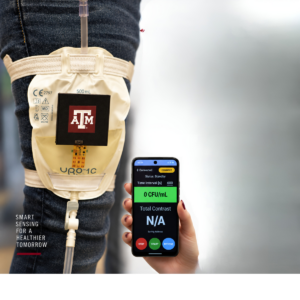
Catheterized patients are particularly vulnerable to UTIs, including infections caused by E. coli. Traditional diagnostic methods often rely on laboratory testing, which can delay results and potentially slow treatment decisions. This technology uses a wearable fluorescence sensor to detect E. coli directly in catheter bags, providing automated results within hours rather than days.
A companion smartphone application enables continuous monitoring of sensor data, provides notifications and displays estimated E. coli concentrations, creating the potential for earlier identification of infection and more timely clinical intervention. The technology can also be used with urine collection cups, expanding its potential beyond catheterized patients. The technology has reached the proof-of-concept stage, with a working prototype demonstrated in a laboratory setting.
Market Applications
Potential applications include hospitals and nursing homes, medical device and diagnostic products, and hospice and home care settings. The technology could support faster UTI detection and continuous monitoring across both clinical and at-home care environments.
Commercialization Opportunity
The technology is available for licensing or sponsored research opportunities. Learn more about the technology and its commercialization potential.
To learn more about this technology or discuss licensing opportunities, contact Ankur Dayal, MS, MBA, Senior Licensing Manager, at adayal@tamus.edu. Additional details about the technology are available online, along with other innovations currently available through Texas A&M Innovation.